Modifications
Handrails: Requirements, Height Standards & Permits
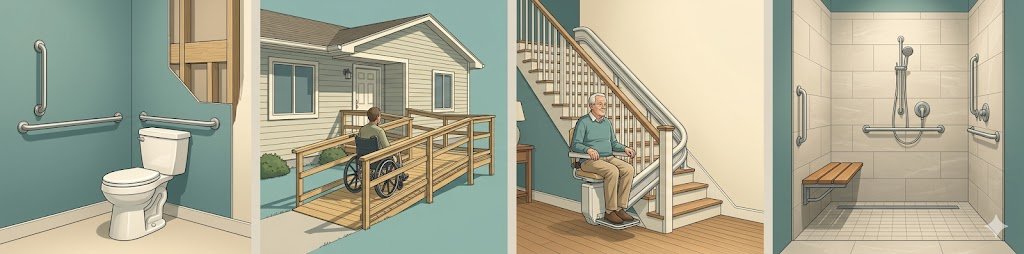
Updated June 2025 — Code requirements for residential stairs
Why Handrails Matter
Falls on stairs are a leading cause of serious injury among older adults. Properly installed handrails on both sides of every staircase are one of the highest-impact, lowest-cost safety modifications available. Yet many older homes have a handrail on only one side, or have handrails that don't meet current code standards for graspability or height.
Current Residential Code Requirements (IRC)
- Required when: Any staircase with 4 or more risers requires at least one handrail
- Height: 34–38 inches above the stair nosing (the front edge of each step), measured vertically
- Graspability: Round handrail: 1.25–2 inch diameter. Non-round (shaped) profile: perimeter 4–6.25 inches with a maximum cross-section dimension of 2.25 inches
- Extensions: Handrail must extend horizontally at least 12 inches beyond the top riser and continue the slope for one full tread depth beyond the bottom riser — these extensions allow users to stabilize before stepping onto or off the stairs
- Both sides: Not required by residential code for private homes, but strongly recommended for accessibility; required by ADA for public facilities
When Is a Permit Required?
Replacing an existing handrail with a new one of equivalent design: generally no permit required in most jurisdictions. Adding a new handrail (new fastening to wall, new post installation): building permit may be required. Adding a handrail to stairs where none existed: usually requires permit. Always confirm with your local building department. Permit fees for handrail work are typically low ($50–$150).
Installation Considerations
- Wall-mounted handrails must anchor into studs or use appropriate wall anchors rated for the expected load — a person grabbing a handrail during a fall can exert 250+ lbs of force
- Post-mounted handrails (for open staircases) must anchor to framing, not subfloor surface only
- Continuous handrails (no interruptions at landings or turns) are safer than segmented ones
Recommended Product
Moen Home Care 32” Stainless Steel Grab Bar
The most widely specified residential grab bar among CAPS contractors and VA-approved installers. Stainless steel, concealed screws, available in multiple lengths and finishes. $24.48 — 300+ purchased last month.
View on Amazon →As an Amazon Associate, AccessReadyHome earns from qualifying purchases at no extra cost to you.